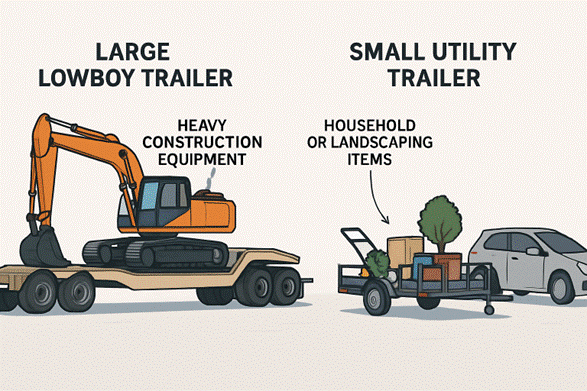
Trailer types are highly dependent on how effectively each type moves tools, product materials, or equipment, from one location to another and how they apply to your specific hauling needs. There are two primary types of Trailers commonly used in the Hauling Industry, Utility Trailers and Lowboy Trailers. The type of trailer that you choose will ultimately determine the ability to assist you in moving oversize and/or heavy-weight cargo for both contractors and homeowners. On the other hand, Utility Trailers are utilized for their versatility and functionality in hauling everyday types of cargo.
Lowboy Trailers are specifically designed for transporting oversize, heavy-weight equipment or machinery that is not permitted due to excessive weight or size restrictions. A Lowboy Trailer gives you the peace of mind that you will have the ability to safely transport the machinery you require.
Utility trailers can be used by those who are transporting lighter-weight and/or more versatile loads. Utility trailers provide landscapers and hobbyists an affordable hauling option to complete their day’s work. The differences between Utility Trailers and Lowboy Trailers can impact the logistics and safety associated with moving cargo, and the budget associated with any associated project. For each project and load type, you should determine which type of Trailers you wish to use and maximize your ability to be efficient in moving your cargo, based on the frequency of use and the type of cargo to be transported.
Understanding Lowboy Trailers
Lowboy trailers have ultra-low deck heights, allowing very tall equipment to be loaded into them. Their design helps prevent equipment that would be too high to meet highway clearance requirements from being moved on a standard trailer. By eliminating the potential for clearance related delays, lowboy trailers enable the legal transport of oversized loads along public highways.
The other aspect of lowboy trailers that provides a logistics advantage for industries needing to move industrial, mining or agricultural equipment is the sturdiness of their frame coupled with a customised design. As a result, lowboy trailers improve safety on our roads while increasing productivity at job sites. Therefore, lowboy trailers are essential for both major infrastructure and long-haul routes.
Key Features of Lowboy Trailers
The design of the Low Deck Support provides required clearance for the transportation of tall loads to travel through tunnels, under elevated roadways, etc. All Low Decks Support except for one model has a minimum capacity of 80,000 lbs. – the majority have a much higher available capacity depending on axle configurations and DOT regulations in each state.
RGN’s are an easy and helpful loading/unloading method for any user who moves heavy equipment. Most users see this as a key feature.
Having a variety of axle configurations allows the ability to distribute weight, meet state laws and improve stability when operating on different types of surfaces.
Applications of Lowboy Trailers
Lowboy trailers play an important role in many industries including construction, mining, and agriculture. Many companies transport heavy equipment such as bulldozers, excavators and cranes on lowboys, therefore they have become an integral part of any company’s logistics for transporting oversized and/or overweight loads. The design of the lowboy allows safe transportation of equipment, even on the most demanding heavy haul jobs.
Understanding Utility Trailers
The utility trailer is known as the Swiss army knife of the hauling industry. Because of the numerous options available, along with low price points and user friendly design, utility trailers offer an impressive range of uses. They will not compare in heavy-load capacity to a low-boy trailer but they can come in very handy for everyday tasks, such as hauling gardening supplies or transporting building materials when doing renovations. Because they are lightweight and simple, they can be towed by most vehicles, including everyday pickup trucks and SUVs. This opens up many options for both everyday users and businesses.
There are several sizes and configurations of a utility trailer to fit all types of needs. For example, there are compact utility trailers that are perfect for doing simple jobs, as well as larger utility trailers that can transport either small machines or several pallets of product at once. The great versatility of utility trailers makes them a staple of many small businesses and homeowners who need to do many projects throughout the year.
Applications of Utility Trailers
Small contractors, farmers, landscapers and landscapers all benefit from the simplicity of utility trailers. These trailers are designed specifically to transport a wide range of items including mowers, weed trimmers, bales of hay, and agricultural implements. Utility trailers provide homeowners with the ability to complete many different types of DIY projects; they can be used to haul items (such as yard waste), move large items (e.g., furniture), or deliver bulk products between locations.
Choosing the Right Trailer for Your Needs
There are four main factors to consider when determining whether to purchase a lowboy trailer or a utility trailer:
1. Size and Weight of Load – The first consideration is the size and weight of the load being transported. A lowboy trailer would be most suitable if you need to haul very heavy or tall loads, while a utility trailer would work well for smaller and/or lighter loads.
2. Frequency of Use – If you plan to haul heavy loads frequently, you will benefit from the durability and utility of a lowboy trailer; however, if you only need to use the trailer infrequently or for smaller loads, a utility trailer might suit your needs better.
3. Cost – Utility trailers are generally the least expensive option when considering long-term investments. If you are starting a business or using the trailer for recreational use, you probably cannot justify spending money on a lowboy trailer.
4. Compatibility with Vehicle – It is crucial to ensure that the trailer you buy is compatible with the vehicle that will be towing it; otherwise, you risk safety and efficiency issues while transporting your load.
Final Thoughts
When selecting a trailer to be used in your business (Construction, Agriculture), you should think about your business type (Construction / Agriculture), whether the requirement is repetitive or sporadic use of the trailer, how frequently you are planning on using the trailer (once or multiple times), how much money you can spend on a trailer and the trailers that will suit your business. Lowboy trailers are most suited for transporting tall and heavy equipment and Utility trailers are useful for transporting a variety of products. By carefully considering all of these factors before you purchase a trailer, you will increase your project’s safety and productivity by selecting the trailer that best suits your needs.