
Conveyor systems are fundamental to the management of warehouses to transfer goods between storage, packing, and dispatch sections. However, not every conveyor configuration provides a steady flow in the workstations of various items, particularly where layouts differ and handling needs fluctuate.
Consequently, there may still be delays, unbalanced movement, and manual intervention. Thus, these restrictions cause congestion, delay turnaround time, and place pressure on workers.
That is why more flexible transport solutions are necessary in the warehouse settings. Roller conveyors are one of these solutions and offer smooth movement of products with low resistance and flexible designs across layouts.
Also, they are easy to handle due to their simpler structure, unlike more rigid or powered systems. Consequently, work processes become more predictable, regulated, and manageable.
This article describes how roller conveyors enhance the operations at the warehouse and contribute to the effective material flow.
1. Efficient Movement of Goods Across Work Areas
The effective flow between work areas in any warehouse directly affects productivity. Nevertheless, in cases where conveyor systems do not align with particular workflows, goods might need to be handled further between processes. Therefore, delays are increased, and the overall efficiency is reduced.
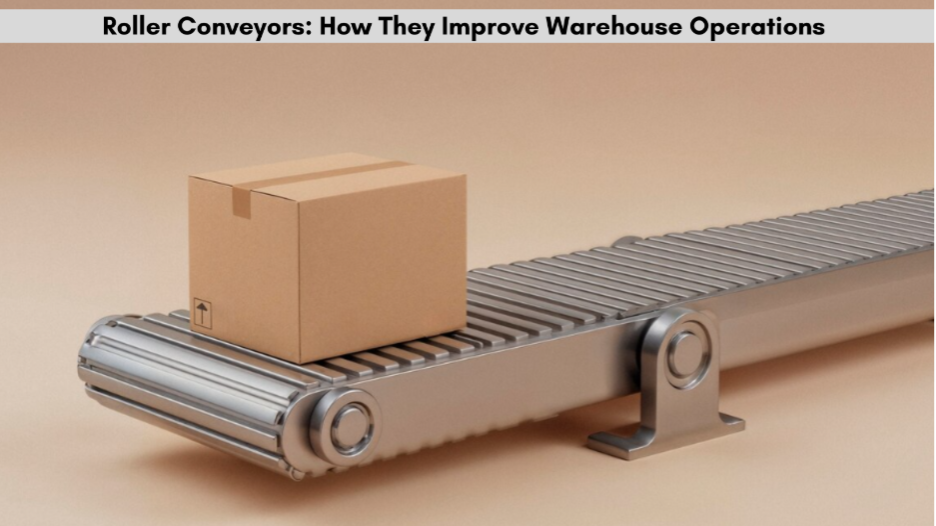
This is where the roller conveyors have a practical benefit. In particular, these systems rely on precision rollers on the stable frames, which move goods smoothly with minimum resistance. Consequently, steady roller positioning provides a steady flow and minimizes time loss on transit.
Moreover, products are constantly transferred in the receiving, storage, and shipping areas. Due to this, manual handling is reduced, and the process flow becomes better. This, in turn, makes the operations quicker, more reliable, and manageable in various regions.
2. Modular Conveyor Layouts for Flexible Warehouse Design
The designs of warehouses tend to vary with the changing storage requirements, types of products, or workflow requirements. Nonetheless, fixed-structure conveyor systems may not be as flexible and may demand significant modifications in case updates are necessary.
On the contrary, the roller conveyors have a modular design. Consequently, adding, removing, and rearranging sections can be implemented depending on the operational needs. Moreover, width, length, and roller spacing are adjustable in accuracy to product size and workflow requirements.
Due to such flexibility, layouts can be consistent with business operations. Besides, new stations can be incorporated without affecting the existing systems. Thus, warehouses are able to adjust layouts effectively without interrupting day-to-day operations.
3. Reliable Material Flow with Precision Roller Systems
A constant flow of materials is vital to prevent any form of delays in the operations of the warehouse. Nonetheless, the lack of stability or alignment in conveyor systems usually results in unwanted movement and bottlenecks.
To avoid this, roller conveyors have precisely aligned rollers and rigid framing to provide controlled motion. Moreover, the roller spacing is uniform, which maintains a steady position of items on the conveyor line.
Consequently, goods flow freely in the stations, helping the sorting, inspection, and packing operations to take place without any interruptions. This results in better coordination of the workflow and in the minimization of disruptions between linked operations.
4. Durable Construction Supporting Long-Term Operations
Warehouse systems need to work with a wide range of loads and conditions in a continuous state. Nevertheless, conveyor systems that have low-durability components may need regular maintenance, which halts operations.
To overcome this, roller conveyors use precision-engineered aluminum frames and durable rollers for structural stability. As a result, they support long-term use while maintaining consistent performance under continuous operation.
Moreover, integrated bearings enable smooth rotation with minimal resistance. Because of this, mechanical wear is reduced, and maintenance requirements remain low. Therefore, warehouses can maintain reliable performance without frequent downtime.
5. Seamless Integration with Warehouse Transport Systems
Modern warehouse operations depend on connected systems across multiple stages. However, when conveyor systems do not integrate properly, workflows become fragmented and inefficient, which can lead to delays and inconsistent handling between processes.
To ensure coordination, roller conveyors can be integrated easily with packing stations, sorting areas, and other conveyor systems. In addition, their modular design allows smooth transitions between different workflow sections.
Furthermore, standardized components simplify alignment with existing systems and support structures. As a result, goods move efficiently across operational zones, which improves overall workflow continuity and reduces unnecessary handling between stages.
6. Versatile Transport for Diverse Warehouse Applications
Warehouses handle a wide range of products across different operational stages. However, using separate conveyor systems for different load types increases complexity and reduces efficiency, especially in environments with varying product sizes and flow requirements.
To address this, roller conveyors support cartons, containers, and other flat-based items across workflows. In addition, configurations such as single-track, double-track, and multi-track systems allow multiple product flows within the same setup.
Because of this flexibility, both simple transport paths and more complex distribution systems can be managed effectively. As a result, warehouses maintain consistent performance while adapting to changing operational demands and varying throughput levels.
Bottomline
Efficient warehouse operations depend on smooth and continuous material movement across all stages. However, when conveyor systems lack flexibility or require frequent manual intervention, delays and inefficiencies begin to affect overall performance. As operations expand, maintaining a consistent flow becomes increasingly challenging.
For this reason, roller conveyor systems provide a practical and adaptable solution for internal transport. By supporting controlled and steady movement, they help maintain organized workflows across different areas.
In addition, modular design allows flexible layouts, while precision components ensure reliable performance over time. As a result, warehouses can improve efficiency, reduce operational disruptions, and respond effectively to evolving demands.